



Hey friends, Hossein here 👋
As promised, from now on, genuinely useful stuff only.
I’m not abandoning technical deep dives or end-to-end build tutorials (still love shipping code with you). But let’s always tie them to what actually creates value, product thinking and real impact.
(And when you just need raw implementation speed, Cursor or your favorite AI coder has your back anyway!)
So Let’s cut through the endless AI noise today and talk about what truly moves the needle in 2026.
1- Right now, the internet is drowning in AI tutorials 🤯
RAG this.
Agents that.
Stacks, frameworks, patterns, recipes.
Most are technically spot-on.
Most also completely miss the point.
Because the hard part in AI engineering today isn’t how to build.
It’s deciding what is worth building in the first place.
Code has never been faster ⚡
And yet, teams still feel confused.
Not because they can’t ship.
But because they’re shipping the wrong things.
This massive gap gets almost zero airtime.
Even though it’s the only one that matters.
And it’s exactly why we’re seeing the rise of the Product Engineer 👀
2- The real bottleneck, buried under AI noise 🤯
This is the part most tutorials skip 🤫
Andrew Ng nailed it in a recent talk - simple, but it stings:
when it becomes easy to go from a well-written spec to working code, the bottleneck moves.
Not to engineering.
To deciding what to build and writing a clear spec in the first place.
AI turbocharged implementation ⚡
Judgment? Still waiting for its upgrade 🧠
When I build things, I don’t think in straight lines. I think in loops:
Build → show users → get feedback → rethink → iterate.
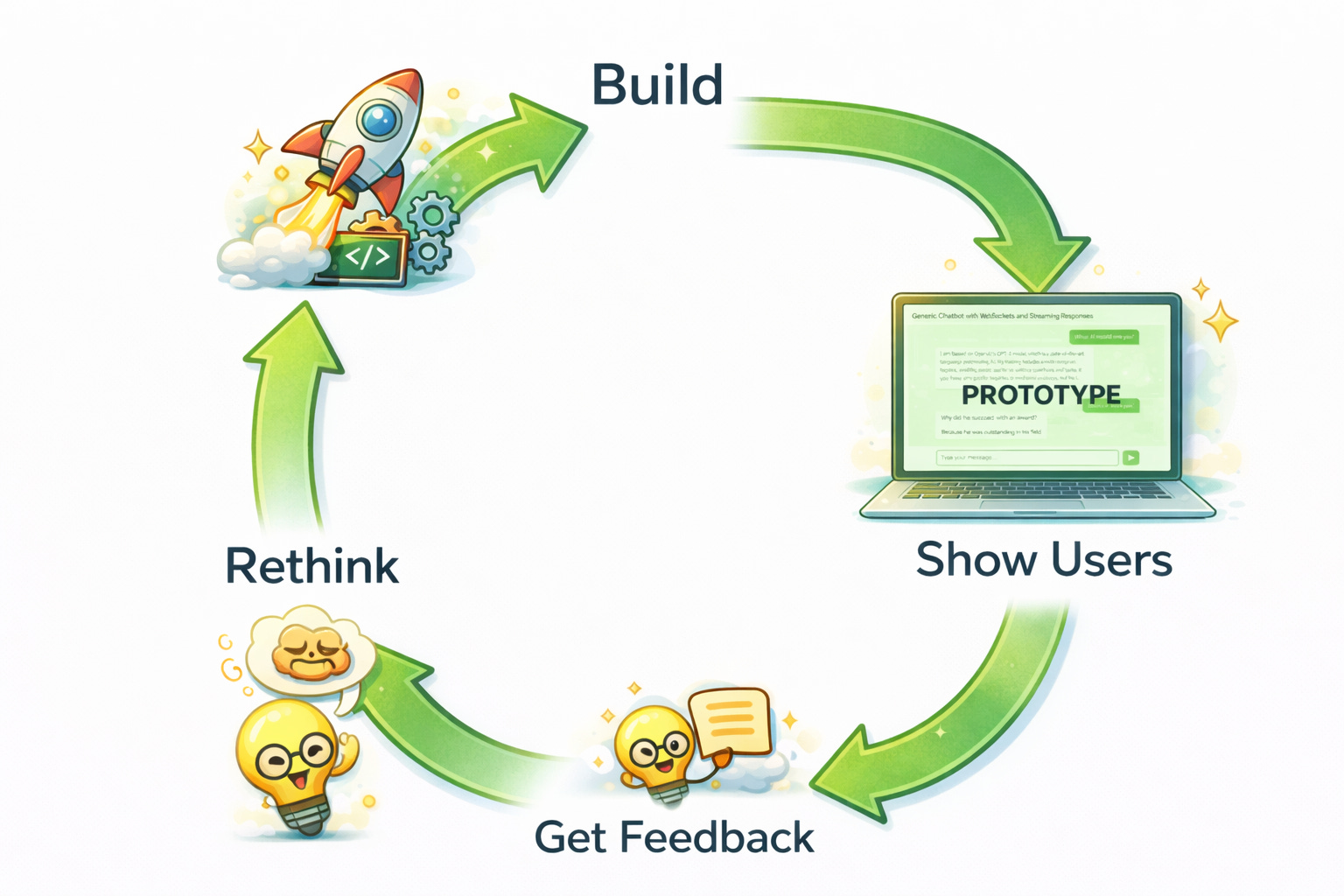
(Remember Lean Startup? That Build-Measure-Learn loop never went away, it just got way cheaper to run.)
That loop is product work.
And yes, it usually means bothering users more than they’d like (sorry 😅).
Only half of that loop got faster.
So while engineering velocity exploded, the work of shaping the right thing to build stayed stubbornly human.
And that human half going to be pure gold in 2026 and beyond ✨
3- When the Engineer-PM Loop Starts to Collapse 👀
Andrew highlighted one trend that really stood out to me.
Old-school Silicon Valley rule of thumb: PM-to-engineer ratios like 1:4, 1:7, even 1:8.
One PM keeping an army of engineers happily busy with specs.
What he’s now observing is that these ratios are shrinking, with some teams moving closer to 1:1.
That alone already changes an engineer’s day-to-day.
It means tighter collaboration, shared context, and much less distance between decisions and execution 🤝
But there’s a more interesting pattern emerging.
Engineers who can actively shape the product, not just implement it, are becoming incredibly valuable.
That’s when the classic engineer ↔ PM ping-pong game collapses into one fast human.
And that’s where the real magic ignites 🚀
4- Meet the Product Engineer 👩💻🧠
The Product Engineer is the new powerhouse in tech, an engineer who doesn’t just build code, but owns the entire product loop from vision to validation.
They code fluently (often supercharged by AI tools) while deeply understanding users, spotting unmet needs, and deciding priorities without endless handoffs.
No more waiting for specs from a separate PM - they write prototypes in hours, show them to real users, gather raw feedback, and iterate relentlessly.
This collapses the traditional engineer-PM divide into one person, eliminating bottlenecks and unlocking insane velocity.
What makes them unstoppable:
Technical depth + product intuition: They know what’s feasible to build and what’s worth building, avoiding wasted effort on shiny but useless features.
User empathy as a superpower: They talk directly to users, build mental models of pain points, and refine ideas based on real behavior - not assumptions.
Rapid closed-loop iteration: Build → Test with users → Learn → Pivot. All in days, not months. AI handles the heavy coding lift; they handle the judgment.
Outcome ownership: They don’t ship features - they ship solutions that users love and that drive real impact (retention, revenue, delight).
Not every engineer wants (or needs) this role - some thrive in pure implementation.
But those who do? They’re the ones moving fastest, launching hit products, and shaping the future of AI apps.
5- How to Level Up to Product Engineer (Starting Today) 🚀
You don’t need a title change or permission. Start small, compound fast.
Get dangerously close to your PM colleague: Ask to sit in on their user interviews, roadmap debates, or prioritization rituals. Offer to take notes (or bring coffee). Warning: you might actually start enjoying those “lovely discussions” 😏
Shadow PM calls (yes, really): Hop on customer discovery, support deep-dives, or sales demos. Listen for the unfiltered chaos. One hour of this beats months of spec-reading - and you’ll finally understand what PMs mean when they say “it depends.”
Talk to 5 real users this week: DM customers, book quick calls, ask “What’s the most frustrating thing about [tool] right now?” Pro tip: users lie less when you’re not hiding behind a survey.
Ship one tiny experiment: AI-prototype a micro-feature in a day. Show it to those users and loop in your PMs for quick feedback, they’ll spot the “why” gaps you missed and probably get excited you’re thinking like them. Watch what people actually click (spoiler: rarely what any of us expected).
Train your empathy muscle daily: Read one raw user interview or support ticket. Ask yourself: “What emotion is hiding here?” Soon you’ll spot pain points before they’re roadmapped.
Own outcomes on your current work: Next ticket that lands in your lap? Ask “Why this? Who actually wins? How will we know users love it?” Your PM will high-five you (or at least smile hugely) - because suddenly you’re the engineer they love working with: proactive, user-aligned, and shipping things that actually matter.
Mandatory side project: Build something completely solo. No handoffs, no mercy. You define the problem, talk to strangers, code, ship, cringe at feedback, repeat. Fastest empathy bootcamp on earth.
Do this consistently for 3 months? You’ll develop product judgment no tutorial can teach.
You’ll move faster than pure coders… and become the engineer every PM fights to keep on their team 😉
(Personally, I love PMs ❤️ Nothing beats the moment they light up because an engineer actually understands them and wants to build the right thing together)
The opportunity is wide open in 2026.
Go close the loop.
And build things people actually love ✨